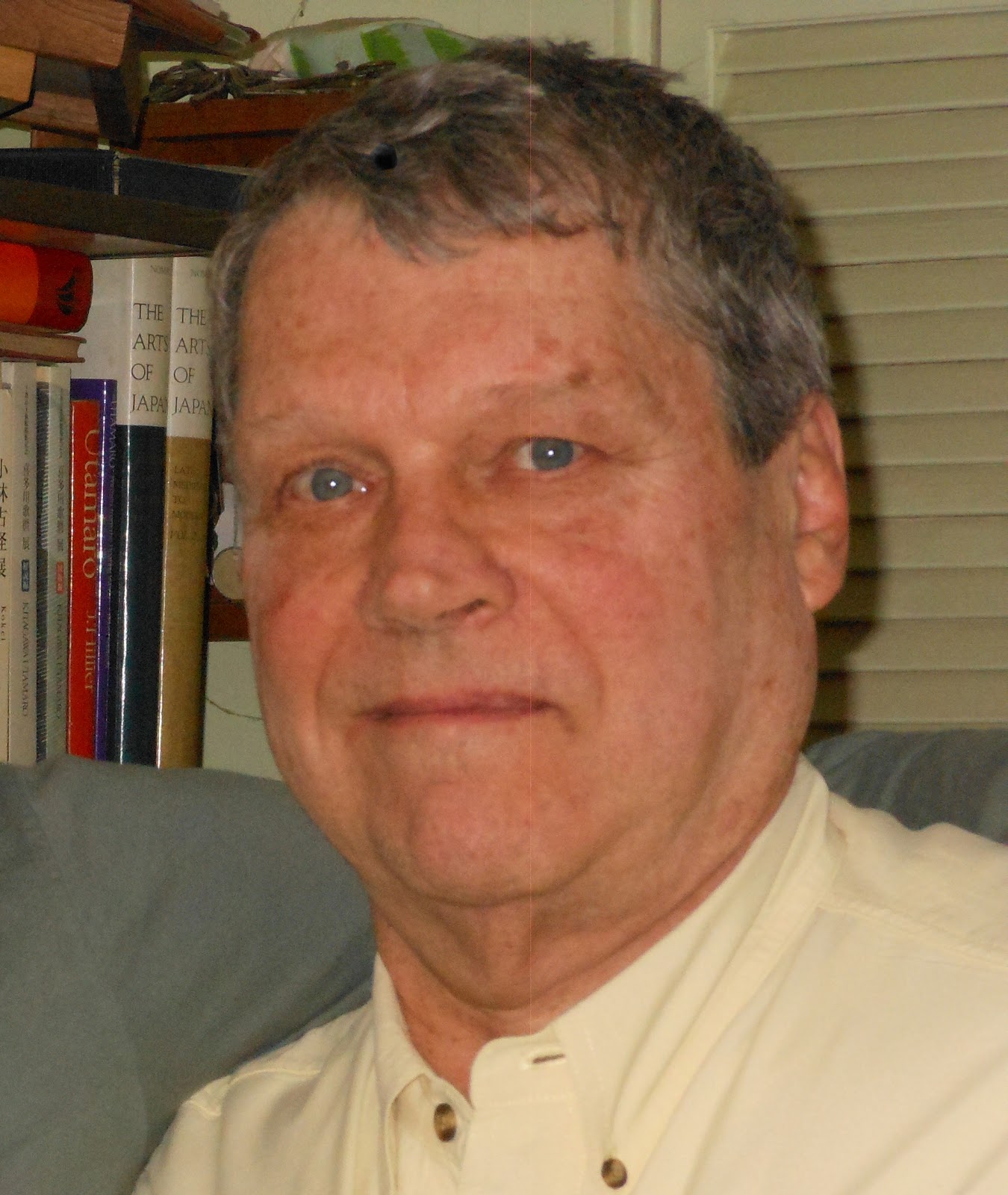
Christopher P. Stephens, Bookman

Chris Stephens has been a book dealer since 1965 - earlier if you count childhood buying and selling.

Stephens has sold major collections to university libraries all over the world. He has operated appealing bookstores in Mt. Carroll, Illinois, Hastings on Hudson, NY and several in NYC, NY. He is a wholesale dealer to other bookstores all over the world.

Chris loves books.

Stephens now maintains a lively internet operation out of his new home in Scranton, PA.


Thursday, July 4, 2013

John Hancock and the Declaration of Independence


John Hancock put the most famous signature to the Declaration of Independence even though he was not the most famous signer.  His signature made its way into riverrun en route to The University of Texas. 
The document was an appointment, of someone name Robbins, to military office.  Hancock signed in his capacity as governor of Massachusetts. With awe, I scanned the document.
The Hancock signature is large and bold.  He signed the Declaration of Independence as the president of the Continental Congress.  The confidence expressed in that signature lent additional authority the Declaration that we celebrate today.

But isn’t it interesting that we have selected that document, that event, to mark the beginning of our country?
Lots of revolutionary activity went on beforehand.  The Committees of Correspondence were established well before 1776.  The Boston Tea Party took place in 1773 and the First Continental Congress met in 1774.  Those key early battles at Lexington & Concord were fought in 1775 and so was the Battle of Bunker Hill.
The Green Mountain Boys captured Fort Ticonderoga and valuable cannons and the Second Continental Congress sent “The Olive Branch Petition” to King George lll all before the Declaration of Independence was issued.

If I were writing the history books, I wouldn’t date the beginning of the USA to the signing of the Declaration of Independence.  I would date it neither from the restive disturbances and outright battles of the early 1770s nor from any of the many battles of the Revolutionary War, not even the one at Yorktown in 1781 when General Cornwallis surrendered.
For myself, I select the 1787 summer of the Constitutional Convention as the birth of the United States of America.  My USA is 230 years old this summer.  Not everyone would agree, but I have my reasons. Nevertheless, I am perfectly happy to celebrate on this day that others have chosen.
Actually, I am impressed with my fellow Americans in selecting the publication of our Declaration of Independence as the most significant moment in the birth legend of our country. 

It is with the glory of oratory, not of battle, that we choose to date our beginning.

Wednesday, June 19, 2013

Helen Keller


Two incredibly talented women, Helen Keller and Ann Sullivan, somehow wove communication out of some other warp than sight; some other weft than hearing.

Keller was “trebly defective”: blind, deaf, and mute.  Sullivan also faced triple obstacles: partially blind, mistreated in childhood, and parentless young. How did they manage to overcome such formidable hardships?  It couldn’t have been done with only one incredibly talented person.  Both had to be remarkable.  Both were.

Helen Keller went on to live a generous life of helping others, especially children.  She campaigned for better treatment of people with physical disabilities.  This letter, which found its way into riverrun, is of another one of her areas of interest.

The civil war in Spain, just like any war anywhere, left children without family, without country.

The sentiment in the letter is well expressed.  It is the careful signature at the bottom, though, that is so very poignant and so very admirable.  


A 1930 newsreel with Keller and Sullivan demonstrating how Keller learned talking from Sullivan.  Fascinating.

very moving newsreel of Helen Keller speaking to disabled youngsters in Australia

American Foundation for the Blind includes a biography and photos of Helen Keller
AFB bio & photos of Ann Sullivan

Article about Basque child refugees in UK

Spanish Civil War: Refugees

autobiographies of Spanish child refugees in a Quaker Home in France

Sunday, June 9, 2013

The Hollywood Ten


The House UnAmerican Activities Committee was, as a phenomenon, first cousin to an oxymoron.

How could the persecution of people for what they believe possibly be considered American? Wasn't there a Big Fuss over the U.S. Constitution? All those states refused to ratify without the assurance of a Bill of Rights to protect the individual from a frivolously malicious government.  A frivolously malicious government.

Nevertheless Senator Joseph McCarthy was able to take over the reins of the HUAC and tromp over much touted American freedoms.

The government printed pamphlets of all that tromping.  riverrun recently got whole boxes of the House UnAmerican Committee Proceedings.

The Hollywood Ten and Blacklisting are representative of the havoc wrecked across many industries in many regions of the country.
In 1947, members of the movie industry were brought before the committee as accused Communists.  The accusation in itself, at that time, carried the implication of treason or near-treason. Some people squirmed and cooperated with the committee.  The Hollywood Ten didn't.  They faced inquisition because anonymous "friendly witnesses" had suggested their names to the HUAC. As a group, The Ten refused to play the HUAC game. They were jailed for contempt of congress.

Who were they?

alphabetically:

Alvah Bessie - 1904 - 1985 - went to Columbia University - worked in theater - wrote short stories, novels and screenplays - leftist political views - volunteered in the Spanish Civil War -theater and film critc -later wrote Inquisition in Eden about his bout with the HUAC -sentenced to 12 months prison and fined $1000.

website by his son, Dan Bessie about books etc. http://www.alvahsbooks.com/ books.com


Herbert Biberman - 1900 - 1971 - attended Yale and Univ PA - joined Theater Guild - stage manager and director - wrote and directed B movies for Warner Bros. - 1950 served 6 months in prison and blacklisted

YouTube excerpt of HUAC bullying and Biberman resisting:


Lester Cole - born 1904 NYC – high school dropout - actor - screenwriter - one of the founders of Writers' Guild - joined ACP in 1934 - wrote many screenplays, after blacklisted could only sell screenplays under other peoples' names - wrote autobiography Hollywood Red -paid $1000 fine and served 10 months in prison and then was blacklisted


Edward Dmytryk  - 1908 – 1999 – born in Canada, Ukrainian grandparents - served time in jail but lost his resolve.  He gave the HUAC names of alleged Communists to win release from the Hollywood Blacklist. He was an employable director again. Wrote Odd Man Out: A Memoir of The Hollywood Ten about that time and some books on directing including On Film Editing which advises that every scene should begin and end with continuing action.

somewhat pitiable attempts at justifying himself + film advice:
bio and more info on the times:


Ring Lardner, Jr  - 1915 – 2000n – wrote screen plays (also books) – fined and served a full year in prison for contempt of congress – even after he was released, he had to get non-blacklisted friends to front his screenplays for him – went on to do impressive work, eventualty under his own name again.

Very nice life timeline and filmography:

somewhat scrambled info:

John Howard Lawson - 1894 – 1977 – screen writer – helped organize The Screenwriters’ Guild – worked, then later volunteered for Red Cross in World War I – formally protested Sacco and Vanzetti trial.  – he was fined, imprisoned and blacklisted for his refusal to talk to HUAC – moved to Mexico after release from jail and wrote under pseudonym.

Site set up by Lawson’s son, Jeffrey, includes bio and much more:
http://www.johnhowardlawson.net/Home_Page.html

Intro and transcript of part of Lawson’s hearing:

Albert Maltz  - 1908 – 1985 – a talented, well-educated, and successful and rich screenwriter, Maltz struggled with ideas and creativity – he was a sympathetic member of the Communist party but bridled under the party’s push to have writers be spokesmen for the party.  In his famous essay, Maltz says, “It has been my conclusion for some time that much of the left–wing artistic activity—both creative and critical—has been restricted, narrowed, tuned away from life, sometimes made sterile—because the atmosphere and thinking of the literary left–wing had been based upon a shallow approach…" "I have come to believe that the accepted understanding of art as a weapon is not a useful guide, but a straitjacket.”

NY Times Obituary:

Accolades and bio information by an admiring family member:

Samuel Ornitz - 1890 – 1957 -  social worker for New York Prison Association and for Brooklyn Society for the Prevention of Cruelty to Children – later a screenwriter – outspoken advocate of the Soviet Union – like the other 9, he was fined, imprisoned and blacklisted.  Later he lived in Mexico and wrote novels.

These novels were apparently more substantial and experimentally creative than generally acknowledged -- except here:

bio:

Robert Adrian Scott  - 1912 – 1973 – writer, later producer – especially film noir – after HUAC and blacklisting his second wife, Joan LaCour fronted for his screenplays.

Mini biography includes some interesting family relationships:

CIA testimony from congressional hearings:

Dalton Trumbo - 1905 – 1976 – lived in western USA – held various jobs during the depressed years – screenwriting starting in 1934 – in 1947 defied HUAC and was punished along with the rest of the Hollywood 10 - Blacklisted but was very active writing from Mexico City ad then southern California behind fronts and under assumed names -  a movie written under the assumed name, Robert Rich, won an Academy Award which presented a puzzle since award winner “Rich” seemed mysteriously non-existent.  The award ceremony was in 1957 – 3 years after Senator Joseph McCarthy had been censured by the Senate for his wild excesses.  Trumbo revealed himself behind the fake name.  Shortly afterwards he was credited for several other hits and the lengthy decade of Hollywood Blacklisting was effectively over.

San Francisco Chronicle – includes photographs:

American Masters biography:

American Communist Party

A lengthy and extremely interesting article, including several YouTube documentaries and extensive quotations both sympathetic to and horrified by McCarthyism

Saturday, April 6, 2013

Thank you, Anne Fadiman


   Anne Fadiman may be responsible for riverrun’s survival and we never thanked her properly.  In fact, though profoundly grateful, we never thanked her at all.
     The transition from riverrun owner Frank Scioscia, who always subsidized the bookstore quite heavily, to his son in law Chris Stephens, who did not have the luxury of outside funds, was fraught with peril.  At one very dark moment I was beginning to wonder if we could make it.
Then there was a miracle.  Someone told us that they’d read a zippy article about the store.  Several other customers came in telling us how they’d read of riverrun in a complimentary article by Anne Fadiman.  We didn’t know Anne Fadiman.  A stranger had discovered us!
     Someone brought us the article from the Library of Congress magazine, Civilization.  We loved it.  It isn’t really an essay about riverrun.  It is an essay about the love of books, the way books furnish an outward environment for the inward self, and about a husband who has the good sense to share one’s love of books.  Only incidentally does the essay mention a birthday surprise expedition to riverrun bookshop, the long browse there, and the 19-pound purchase carried back to New York City.  The way we read it though, it was an essay about riverrun.  It buoyed our spirit and strengthened our will and eased our way across the difficult transition.
     We taped that article to the front windows of riverrun and it continued to smile at us daily as we came into the store.
     Seasons passed.  The ink from the article transferred itself to the window glass.  The paper became brown and tattered but remained in place until the landlady had to replace the store windows.
     Gone with the discarded old windows!  Why hadn’t we made copies of the article when it was fresh and new and still readable?
     No matter.  Anne Fadiman’s collected essays from Civilization were published by Farrar, Straus and Giroux in a wonderful book called Ex Libris.  The essay mentioning riverrun is the last in the book, “Secondhand Prose”.  Clever.
     My first copy of Ex Libris was given to Chris and me by a beaming customer.  Re-reading “Secondhand Prose” was such a pleasure that I read and reread every essay in the book, oblivious to all else.  I read them again today when I took this book out to scan for the blog.
    These essays are perfect.  I wanted more.  Luckily there are more.  I just ordered another couple of books by Anne Fadiman.  At Large and At Small and The Spirit Catches You and You Fall Down.  I have a treat coming in the mail.
     Not everyone knows about these jewels.  Why not? For one thing essays are hard to categorize.  I know of a case of mis-categorization.
     Our daughter Mary – quite a good bookwoman herself – was working at a bookstore in Memphis.  Mary was keeping a low profile for reasons of her own, but she couldn’t keep silent when she saw Ex Libris shelved in the foreign language section.  “This book isn’t written in a foreign language,” she told another worker.
    “It isn’t?”  He stared at the title, baffled.
     If I had been Mary, I’d have stood on a chair waving the book in the air and making noise.  “This book mentions my family’s bookstore,” I would have shouted.  “And it belongs in a high visibility spot so people can buy these superb essays!”

     I thank Fadiman for those superb essays.  They are a delight to read and to reread.  I also thank her for mentioning riverrun at a point in history when the bookshop might have winked out of existence.

    Thank you, Anne Fadiman, thank you!


Books by Anne Fadiman (all readily available)

Ex Libris
At Large and At Small
The Spirit Catches You and You Fall Down
Rereading: Seventeen Writers Revisit Books They Love (edited by Fadiman)

Bio from Yale:

article and interview from Atlantic online:


Friday, April 5, 2013

Isaac Asimov


photo by Chris Stephen at NY Book Fair in 1970s

   Isaac Asimov was a scientist and an historian.  He wrote what seems like millions of books (really just over a half thousand).  Most famously, he wrote science fiction but he also wrote an analytic critique of Shakespeare’s plays and he wrote mysteries and hard science and philosophical speculation about the future of humanity.  Through his heroic futuristic novels he opened up, not only the possibility but, the expectation of commonplace human space travel.
   As a young girl, I read Inside the Atom by Asimov and as a teenager I read his sci fi.  I believed it all.
   Asimov was part of an optimistic generation that had survived both the Great Depression and the second world war.  Asimov helped to popularize the miraculous march of science. He and others promised children more from harnessing the power of the atom and more from the space program than has yet been delivered.
   No matter.  He wrote so well that I still believe him.  I’m ready for the spaceports, when they’re built.  At that time I’ll rocket out to explore the great cosmos.  In the meantime I’ll settle into a comfy chair and read another interesting book by Isaac Asimov.

                                                 Isaac Asimov  1920 - 1992


A very appealing 1988 interview of Isaac Asimov by a young Polish
fan, Slawek Wojtowic

A good overall website for Asimov by Edward Seiler

youtube of Asimov extolling the present and future use of computers with libraries of knowledge available to peruse at one’s own speed and along the lines of one’s own interests.


Thursday, April 4, 2013

the missing bit more


Even as a Little Kid, Chris Stephens was a Big Reader.  He was a library regular.  He had an inquisitive mind too, but overwhelmlngly his was an acquisitive mind.  He acquired knowledge.  He acquired information.  He wanted to know things.
     Young Chris read about animals and trees and Native American tribes.  He read history and etymology.  He read about countries where the stamps in his stamp collection originated.  He read about coins and about moths and butterflies.
     Much later, when I met him, he was still collecting butterflies.  He looked great leaping through meadows with his net held high above his head.  Like Vladimir Nabokov, Chris collected moths, butterflies and interesting words.
     Young Chris read mostly non-fiction, but he read some fiction too.  Cowboy fiction.  Science fiction.  Baseball stories.  Comic books.
     Chris acquired so darned much information that he seemed a perfect candidate for the Quiz Kids Radio Show.  In the “green room”, before the show started, the personable Quiz Kids host chatted with Chris, taking notes with which to later betray Chris.
     Young Chris was too short to reach the microphone so an assistant got a couple of telephone books to put on Chris’ chair.  I don’t think those 4-inch thick telephone books even exist nowadays.  Three other kids sat at the table.  They were able to speak into their microphones without the assistance of height boosters.
     The red light went on for live radio.  The host asked questions.  Three little geniuses were eager to answer.  Not Chris.  It wasn’t his style.
    When Chris sat on his hands, even for easy questions, the host took out his notes and asked the kids obscure questions about Native Americans and insects and tiny countries that issued lovely stamps.  The other kids scowled.  Only Chris knew these particular answers.  He didn’t raise his hand though.  Didn’t want to.
    But it was radio.  No one could see whose hand was up and whose hand was quite resolutely down.
     “Ah.  I see little Chris Stephens has his hand up”, lied the host smoothly.  Trapped on live radio by an entertainment professional, Chris was forced to answer questions. He didn’t like it though, and wouldn’t come back to the show.
     Chris went back to the hobbies he loved: collecting interesting things and reading lots of books.  Now, ten Little Chris lifetimes along, these are hobbies he continues to love.
     His disinterests have endured all this time too.  For instance, I’ve always thought that Chris and I would make a great vaudevillian-style comedy team.  His extremely dry humor cracks me up.  He would be the straight man, delivering very funny lines without breaking a smile. For contrast, I’d be only too happy to ham it up a bit.
     Alas.  Even after all this time to reconsider, Christopher Stephens still has no interest in show business.

Clips from old quiz kids shows (Chris’ single show is not included)

NY Times article about Vladimir Nabokov and his alternate identity as  lepidopterist extrodinaire

Sunday, March 31, 2013

CPS 70

Even as a Little Kid, Chris Stephens was a Big Reader.
(Obviously there quite a bit more to this post.  Where is it though?)